Specifications
Description
Product Description
For control of many broadleaf weeds and brush control in corn (field, pop and sweet), sorghum (Milo), soybeans (preplant), small grains (barley, millet, oats, rye, wheat), rice, sugarcane, fallow land, grasses, stone fruits and nut orchards, brush control, pastures, rangelands, forest management and in non-crop areas such as lawns and ornamental turf, drainage ditchbanks, fence rows and rights-of-way . Also for aquatic weed control, control of trees by injection, and tank mixes.Weeds: Alder, Creeping jenny, Kochia, Nettle, Sneezeweed, Tumbleweed, Water plantain, Buckhorn, Goatsbeard, Knotweed, Pigweed, Spatterdock, Vetch, Water shield, Canada thistle, Horsetail, Lupine, Ragweed, Sumac, Virginia creeper, Wild garlic, Cocklebur, Ironweed, Mousetail, St. Johnswort, Thistle, Water Hyacinth, Wild onion
*See product label for complete list
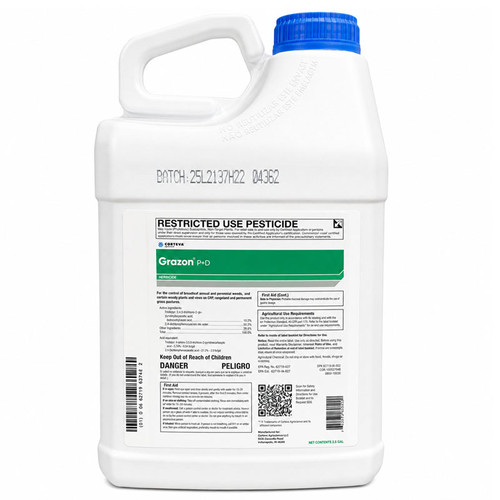
ACTIVE INGREDIENT: Dimethylamine Salt of 2,4-Dichlorophenoxyacetic Acid* . . . . . . . . . .47 .2%
OTHER INGREDIENTS: …………………….…………………. . . . . . . . . . . . . . . . . . . . . . . . . . . . . . 52 .8%
TOTAL: . . . . . . . . . . . . . . . . . . . . . . . . . . . . . . . . . . . . . . . …………………………………....... . . . . .100 .0%
Isomer Specific AOAC Method, Equivalent to: *2,4-Dichlorophenoxyacetic Acid 39 .2%, 3 .8 lbs ./gal
APPLICATION RESTRICTIONS AND USE PRECAUTIONS FOR SOYBEAN Important Notice - Unacceptable injury to soybeans planted in fields treated with this product may occur . Whether or not soybean injury occurs and the extent of the injury will depend on weather (temperature and rainfall) from herbicide application until soybean emergence and agronomic factors such as the amount of weed vegetation and previous crop residue present . Injury is more likely under cool rainy conditions and where there is less weed vegetation and crop residue present . Do not use on low organic sandy soils (<1.0%)
Do not apply this product when weather conditions such as temperature air inversions or wind favor drift from treated areas to susceptible plants.
Livestock Grazing Restriction: Do not feed hay, forage or fodder. Restrict livestock from grazing treated fields. Livestock should be restricted from feeding/grazing of treated cover crops.
In fields treated with this product, plant soybean seed as deep as practical or at least 1.0 inch deep. Adjust the planter, if necessary, to ensure that planted seed is completely covered.
Do not apply this product prior to planting soybeans if you are not prepared to accept the results of soybean injury, including possible loss of stand and yield.
Do not replant fields treated with this product in the same growing season with crops other than those labeled for 2,4-D use.
For the 1 pint (0 .5 lb ae) per acre per application rate, do not apply more than 2 applications per crop cycle.
For the 2 pint (1 .0 lb ae) per acre per application rate, do not apply more than once per crop cycle. The maximum rate per crop cycle is 2 .1 pints of product (1 .0 lb ae) per acre.
ORNAMENTAL TURF AREAS
Lawns (Residential, Industrial and Institutional), Parks, Cemeteries, Athletic Fields and Golf Courses (Excluding Grasses Grown for Seed or Sod Farms).
Use 2 to 3 .16 pints of product (1 .0-1 .5 lbs ae) per acre per application for control of annual broadleaf weeds. Use 3 .16 pints of product (1 .5 lbs ae) per acre per application for control of biennial and perennial broadleaf weeds. Treat when weeds are young and actively growing. Perennial weeds should be near the bud stage, but not flowering at application. Use sufficient gallonage for thorough and uniform coverage.
SPOT TREATMENT IN ORNAMENTAL TURF AREAS (Parks, Cemeteries, Athletic Fields and Golf Courses, Turfgrass (excluding sod farms). To control broadleaf weeds in small areas with a hand sprayer, use 1/4 pint of this product in 3 gallons of water and spray to thoroughly wet all foliage. Do not exceed 4 pints of this product (2 .0 lbs ae) per acre.
USE RESTRICTIONS FOR ORNAMENTAL TURF AREAS (Golf courses, cemeteries, parks, sports fields, turfgrass, lawns and other grass areas) Post-emergence: Do not use on susceptible southern grasses such as St. Augustine. Do not apply to newly seeded areas until grass is well established. Bentgrass, clover, legumes and dichondra may be injured by this treatment. Limited to 2 applications per year. Maximum of 3 .16 pints of product (1 .5 lbs ae) per acre per application. The maximum seasonal rate is 6 .25 pints of product (3 .0 lbs ae) per acre, excluding spot treatments.
GRASSES GROWN FOR SEED OR SOD FARMS Grasses Grown for Seed (Postemergence Use) Seedling grass (five-leaf stage or later): Apply 3/4-1 pint of product (0 .36- 0 .5 lb ae) per acre per application. Well-established grasses: Apply 1-4 pints of product (0 .5-2 .0 lbs ae) per acre per application. Sod Farms (Postemergence): Apply 2 .0-4 .0 pints of product (1 .0-2 .0 lbs ae) per acre per application. Apply when weeds are small and actively growing. For best results, apply when soil moisture is adequate for active weed growth. Do not apply to newly seeded grasses until well established (five-leaf stage or later) and then use a maximum of 1 pint of product (0 .5 lb ae) per acre. Cool season grasses are tolerant of higher rates. Do not apply to grass in the early boot through milk stage if seed production is desired. When grass is well established, higher rates of up to 4 pints of product per acre may be applied for control of hard-to-kill annual or perennial weeds.
Deep-rooted perennials such as bindweed and Canada thistle may require repeat applications . Avoid mowing sod farms for 1 to 2 days before or after application . Delay irrigation until the day following application . Reseeding: Delay reseeding at least 30 days following application . Preferably, with spring application, reseed in the fall and with fall applica tion, reseed in the spring.
Reviews
- There are currently no reviews for this product. Pease write a review by clicking the "Write a Review" button above.